Once a food is consumed, the byproducts in urine can indicate potential nutrition deficiency or excess (e.g., from supplements). This at-home organic acids urine test helps create a map of your metabolism to monitor your health.
NEW! Our Comprehensive Organic Acids test now checks almost 150 markers with a urine tube sample. An interpretative guide can help you understand factors affecting your sleep, appetite, stress levels, dehydration. Unhealthy levels may indicate a need to change your medication and dietary supplements.
The test is performed using Liquid Chromatography-Mass Spectrometry (LC-MS/MS/MS), Automated Chemistry & Immunochemistry for detecting extremely low levels with very high accuracy.
You can also also order additional tests as Add-On: 49 Environmental Pollutants, 16 Mold Toxins, 41 Heavy Metals, and Glyphosate (for recent exposure of herbicides such as Roundup and Weedoff).
The At-home Organic Acids Test is easy, fast, reliable, and requires just a few steps:
Order Online.
Receive Your Organic Acids Test Kit and Collect Sample at Home.
Ship It Back For FREE* To Our World-Class CLIA Labs (US only).
Receive Secure, Confidential, & Easy-To-Understand Report Within Days** For The Most Comprehensive Organic Acids Test.
* Includes FREE shipping of the kit to Canada & most other countries. Free Return shipping to the lab is available only within US.
** Please allow sufficient time to receive the kit, return the sample and testing by the lab. Due to large number of markers, this test may take 10-12 business days to complete testing.
Organic acids are small carbon molecules released into the urine after digestion of foods and liquids.
Each one of these so called urinary metabolite (as they are found in the urine as a results of metabolism) is produced through a series of well-established steps in a biochemical pathway.
They are measurable in urine and serve as functional windows into the nutritional status in many areas including overgrowth of microbes, fungus and yeast and potential exposure to environmental pollutants such as BPA, PFAs.
They can help identify inflammation, detoxification and antioxidant capacity and glutathione as well as need for vitamins and cofactors such as B-vitamins (B1, B2, B3, B5, B6, B12, folate, biotin) and key cofactors (e.g., CoQ10).
Also, organic acids can help with profiling neurotransmitter metabolism of major catecholamine and indole pathways, including dopamine, norepinephrine, and serotonin metabolites, as well as the tryptophan-kynurenine pathway, offering useful insights into mood, cognition, stress response, and sleep regulation.
Similarly, one can potentially understand the role of essential amino acids (leucine, isoleucine, valine, methionine, threonine, and tyrosine pathways that may contribute to fatigue, mood dysregulation, and neurological symptoms) and fatty acid oxidation & ketone metabolism as well as citric acid cycle.
The diagram below summarizes some of the byproducts measured as food is converted into energy.
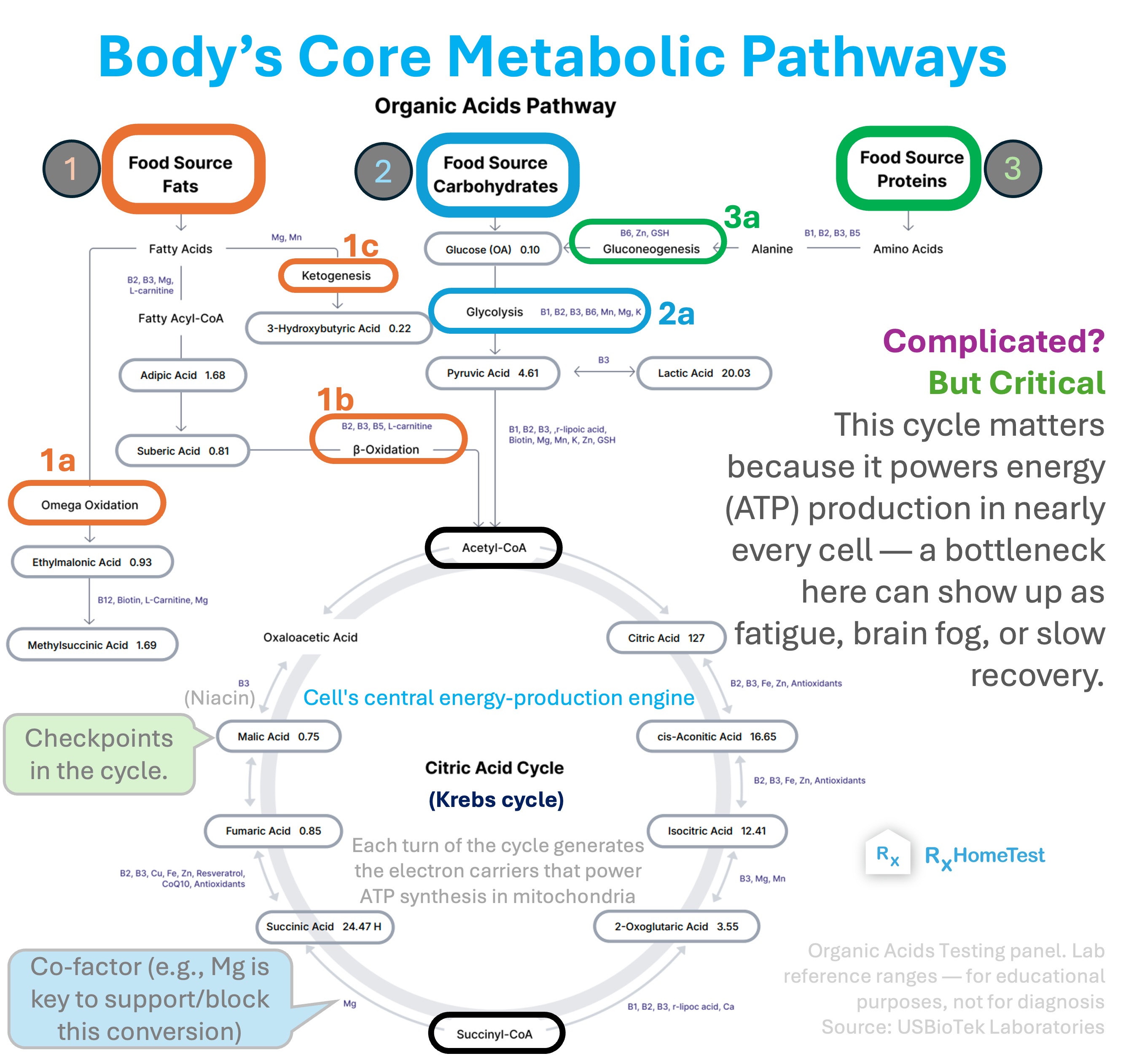
The urine contains products from our metabolism that breaks down a wide range of foods, drinks, drugs, environmental contaminants, waste metabolites of supplements, and bacterial by-products.
By checking their levels and correlating back via their biochemical pathways, it is possible to understand what was consumed and how the body is processing them.
Thus, a test of organic acids provides an excellent opportunity to understand our body's energy production, immune regulation, detoxification, neurotransmitter balance, and nutritional status.
Understanding these compounds can help assess the health of kidneys, bladder, liver and our overall well being.
If you suspect any shortage of specific vitamins, minerals or other nutrients, and are taking supplements for it, the Organic Acid Test is often the recommended option.
Organic acid testing offers a uniquely deep and clinically meaningful picture of a person's metabolic health.
The organic acids part includes approximately 150 markers. These are divided into 12 different segments for better understanding of your results.
1. Microbial Overgrowth - for bacterial dysbiosis and overgrowth of potentially pathogenic organisms in the gastrointestinal tract, including phenolic and aromatic compounds produced by microbial fermentation of dietary substrates.
Key Markers
Benzoic Acid
Hippuric Acid
4-Hydroxybenzoic Acid (4-HBA)
3,4-Dihydroxybenzoic Acid (3,4-DHBA)
3-Hydroxyphenylacetic Acid (3-HPAA)
3,4-Dihydroxyphenylpropionic Acid (DHPPA)
Furancarbonylglycine
Amino Acid Metabolism
Phenylacetic Acid (PAA)
Phenylpropionic Acid
3-Phenyllactic Acid (3-PLA)
2-Hydroxyphenylacetic Acid (2-HPAA)
4-Hydroxyphenyllactic Acid (4-HPLA)
SCFA Metabolism
3-Hydroxypropionic Acid (3-HPA)
Clostridial Markers
4-Cresol
4-Hydroxyphenylacetic Acid (4-HPAA)
Indoleacetic Acid (IAA)
3-(3-Hydroxyphenyl)-3-hydroxypropionic Acid (HPHPA)
2. Yeast & Fungal Metabolites - for yeast and fungal overgrowth, including Candida-related markers such as arabinitol, tartaric acid, and tricarballylic acid, which may interfere with mitochondrial function and nutrient absorption.
Key Markers
Arabinitol
Arabinose
Citramalic Acid
3-Oxoglutaric Acid
Aspergillus Markers
5-Hydroxymethyl-2-furoic Acid
Furan-2,5-dicarboxylic Acid
Tartaric Acid
Fusarium
Tricarballylic Acid
3. Mitochondrial & Energy Metabolism - for functional integrity of the citric acid (TCA) cycle through measurement of key intermediates including citric acid, cis-aconitic acid, isocitric acid, and alpha-ketoglutaric acid (supplements include B Comp, Cr, CoQ10, Lipoic Acid, Amino Acids, Mg).
Carbohydrate & Glycaemic Metabolism
Glucose (OA)
Pyruvic Acid
Lactic Acid
2-Hydroxybutyric Acid
Citric Acid Cycle
Citric Acid
cis-Aconitic Acid
Isocitric Acid
2-Oxoglutaric Acid
Succinic Acid
Fumaric Acid
Malic Acid
Ketone/Energy Intermediates
Acetoacetic Acid
3-Hydroxybutyric Acid
2-Hydroxybutyric Acid
Mitochondrial Markers
Methylsuccinic Acid
2-Methylglutaric Acid
3-Methylglutaric Acid
2-Hydroxyglutaric Acid
3-Hydroxyglutaric Acid
Malonic Acid
Mevalonolactone
2,4-Dihydroxybutanoic Acid
N-Acetylaspartic Acid
3-Methylglutaconic Acid
4. Fatty Acid Oxidation & Ketone Metabolism - for assessing the efficiency of both mitochondrial beta-oxidation and the alternative omega-oxidation pathway through dicarboxylic acid markers, providing insight into fatty acid handling, carnitine sufficiency, and metabolic flexibility.
Key Markers
Adipic Acid
Pimelic Acid
Suberic Acid
Azelaic Acid
Sebacic Acid
Ethylmalonic Acid
Propionylglycine
N-Butyrylglycine
Isovalerylglycine
N-(2-Methylbutyryl)glycine
3-Methylcrotonylglycine
Tiglylglycine
Hexanoylglycine
Suberylglycine
5. Vitamins & Nutritional Cofactor Markers - for functional assessment of B-vitamin status (B1, B2, B3, B5, B6, B12, folate, biotin), glutathione and antioxidant capacity, and key cofactors required for enzymatic activity across multiple metabolic pathways.
B-Vitamin Functional Markers
Methylmalonic Acid (MMA)
Formiminoglutamic Acid (FIGLU)
Xanthurenic Acid
Kynurenic Acid
Quinolinic Acid
Picolinic Acid
3-Hydroxyisovaleric Acid
Vitamin-specific/Antioxidant Markers
Pyroglutamic Acid
N-Acetylcysteine (NAC)
Glutaric Acid (Vit B2)
Pantothenic Acid (Vit B5)
Pyridoxic Acid (Vit B6)
Ascorbic Acid (Vit C)
Methylcitric Acid (Biotin/Vitamin H)
3-Hydroxy-3-methylglutaric Acid (CoQ10)
Pyrimidine Metabolites - Folate Metabolism
Thymine
Uracil
6. Amino Acid & Branched-Chain Metabolism - for the catabolism of essential and branched-chain amino acids, identifying impairments in leucine, isoleucine, valine, methionine, threonine, and tyrosine pathways that may contribute to fatigue, mood dysregulation, and neurological symptoms. For supplements that include B1, B2, B3, B5, B6, B12, Folate, Biotin.
Branched-Chain Ketoacids
2-Oxoisovaleric Acid
2-Oxoisocaproic Acid
3-Methyl-2-oxovaleric Acid
3-Methylglutaric Acid
Succinylacetone
Downstream Metabolites
2-Hydroxyisovaleric Acid
2-Hydroxyisocaproic Acid
2-Oxobutyric Acid
2-Oxo-4-methiolbutyric Acid (KMBA)
Amino Acid Metabolism
Phenylpyruvic Acid
Homogentisic Acid
N-Acetylphenylalanine
Mandelic Acid
Malonic Acid
4-Hydroxyphenyllactic Acid (4-HPLA)
2-Oxoadipic Acid
Guanidinoacetic Acid
Guanidinobutyric Acid
3-Methylglutaric Acid
N-Acetylglycine
7. Neurotransmitter Metabolism - for profiles of the major catecholamine and indole pathways, including dopamine, norepinephrine, and serotonin metabolites, as well as the tryptophan-kynurenine pathway, offering functional insight into mood, cognition, stress response, and sleep regulation. (For Phenylalanine, Tyrosine.)
Inhibitory (Serotonin)
5-Hydroxyindoleacetic Acid (5-HIAA)
Excitatory (Dopamine)
3,4-Dihydroxyphenylacetic Acid (DOPAC)
3-Methyl-4-hydroxyphenylglycol (MHPG)
Homovanillic Acid (HVA)
Vanillylmandelic Acid (VMA)
HVA/DOPAC Ratio
HVA/VMA Ratio
8. Detoxification & Glutathione Function - for evaluation of markers of phase I and phase II hepatic detoxification, glutathione cycling via pyroglutamic acid, and NAC status, reflecting the body's capacity to manage oxidative burden and chemical exposure. For Arg, NAC, Meth, Mg, Antioxidants.
Ammonia Metabolism
Orotic Acid
Glutathione Metabolism
Pyroglutamic Acid
N-Acetylcysteine (NAC)
Glucaric Acid
Phase I / Xenobiotic Markers
2-Hydroxyhippuric Acid
5-Hydroxymethyl-2-furoic Acid
Furan-2,5-dicarboxylic Acid
9. Oxidative Stress & Inflammation - for markers of DNA oxidative damage and inflammatory mediators, including 8-hydroxydeoxyguanosine and leukotriene E4, providing a functional picture of systemic oxidative load. For Vitamin C, Other Antioxidants.
Key Markers
8-hydroxy-deoxyguanosine
Leukotriene E4
Quinolinic Acid
Pyroglutamic Acid
Ascorbic Acid (Vitamin C)
Quercetin
10. Oxalate Metabolism - for markers of excess oxalate production or absorption, which may be associated with gut dysbiosis, dietary factors, or impaired detoxification.
Key Markers
Glycolic Acid
Glyceric Acid
Oxalic Acid
11. Environmental & Xenobiotic Exposures - for urinary metabolites of common environmental chemicals including xylene, benzene, toluene, phthalates, parabens, and endocrine-disrupting compounds such as Bisphenol A (BPA) and Bisphenol S (BPS), providing objective evidence of toxic load.
Toluene Exposure
Hippuric Acid
Benzoic Acid
Paraben Exposure
4-Hydroxybenzoic Acid (4-HBA)
Styrene Exposure
Mandelic Acid
Phenylglyoxylic Acid
Mandelic Acid + Phenylglyoxylic Acid
Benzene Exposure
t,t-Muconic Acid
Phthalate Exposure
Phthalic Acid
Monoethyl Phthalate
Quinolinic Acid
METB Exposure
2-HydroxyIsobutyric Acid
Xylene Exposure
2-Methylhippuric Acid
3-Methylhippuric Acid
4-Methylhippuric Acid
Trimethylbenzene Exposure
3,4-Dimethylhippuric Acid
4-Hydroxyhippuric Acid
Nucleotide Turnover/Methylation
5-Methylcytosine
Uracil
Thymine
12. Others.
Adrenal Stress (Overnight)
Cortisol (OA)
Tryptophan / Kynurenine Pathway (Tryptophan, B6, Antioxidants)
Inhibitory
5-Hydroxyindoleacetic Acid (5-HIAA)
Inflammatory
Kynurenic Acid
Quinolinic Acid
Picolinic Acid
Xanthurenic Acid
Kynurenic/Quinolinic Ratio
Quinolinic Acid/5-HIAA Ratio
Creatinine, Urine
Each report includes a personalised supplementation plan generated directly from the organic acid findings of your individual results.
It is not a generic recommendation but dynamically calculated for each person based on the specific metabolic pattern identified across all measured domains.
A supplements schedule is generated using a proprietary weighted algorithm developed by the lab's clinical and scientific team.
The algorithm analyses the full pattern of organic acid results, not individual markers in isolation.
Then it assigns a weighted score to each finding based on its functional significance, its relationship to nutrient-dependent enzymatic pathways, and its interaction with other metabolic markers present in the same report.
The outcome of this calculation determines both the nutritional priority level (Adequate, Mild, Moderate, or High) and the suggested starting dose for each nutrient, amino acid, probiotic, or cofactor listed.
Important Disclaimer
The Nutrition Guide and supplementation suggestions in each report are generated only for the purposes of clinical decision-support and are not intended as standalone medical advice or a prescription.
The lab's proprietary algorithm used to generate supplement plan is based on established relationships between organic acid biomarkers and nutritional cofactor requirements.
However, it operates solely on biochemical data and cannot account for a person's complete medical history, current medications, existing diagnoses, organ function, pregnancy or breastfeeding status, or any other health condition that may influence the safety or appropriateness of the suggested nutrients and doses.
The final therapeutic decision including whether to implement, modify, or withhold any recommendation in this report rests entirely with the treating healthcare provider.
It is their responsibility to integrate these findings with the full clinical picture before making any therapeutic recommendation.
Our reports do not diagnose, treat, cure, or prevent any disease or medical condition.
An easy, low cost method of measuring your optimal levels is by using a urine test at home, similar to this one. Simply order the test kit, collect the sample at home, ship it for free to our world class CLIA-certified labs, and find out your levels within days. Unlike a blood test, a urine sample makes it especially useful for those fearful of needles.
For a thoroughly detailed discussion on the human urine metabolites, please read this excellent review by The Metabolomics Innovation Center.
A: Except New York and New Jersey our tests are available in all 48 states. State regulations in NY, NJ do not allow us to ship the tests to their residents.
A: The kit contains a urine collection strip, instructions on how to collect the samples, and a form requesting basic information including date and time of collection. The directions are straight forward and easy to follow.
A: You will receive the kit within 3-5 business days with a prepaid return envelope (for shipping within US).
After you mail us the sample and it is received by our lab, the results are available within 10-12 business days. This test takes a little longer due to large number of markers tested over several days using different techniques.
We ship across the world and any address outside US but you will need your help for return shipping to our labs in US.
A: The report with your test results will be easy to understand and will have all the necessary details.
It will mark your levels on a healthy range and will specify what are the expected low and high ranges.
It will briefly discuss what your numbers mean and next steps you should take to maintain healthy levels.
A supplement plan specific to your results will be designed to help with next steps.
A: You can use HSA (or FSA/MSA/HRA) accounts to pay for the tests since these are prescription tests (for further confirmation, please check the IRS publication#969). However, please ensure you are not going outside your specified max and min deductible limits. We do not have the capability to process the insurance claim. Since insurance plans vary for individuals we can not guarantee your HSA payment will always be processed by your plan. We suggest talking to your insurance provider if you have any questions.
A: Measuring urine metabolites is still a new field that is being researched and documented.
The variations in results are mainly from two sources: the way samples are collected and the variation from lab-to-lab.
To minimize the first variation, we provide detailed instructions on how to collect the sample.
To minimize the variation from labs, we have partnered with CLIA-certified labs that are regulated by the states, as well as Centers for Medicare and Medicaid Services (CMS). Majority of the tests from these labs are FDA approved to ensure they meet the proper regulatory requirements. Additionally, the College of American Pathologists (CAP) requires inter-laboratory tests to ensure the ranges established by each lab do not drift or are not out of acceptable ranges. This is done by regularly testing reference samples between different labs. Finally, the labs test thousands of samples for different age groups and health conditions, and have well established reference data to compare your results against this large pool.
A: Unfortunately, no. As a lab test provider we can only test and report out data from your sample. We are not authorized to provide any medical recommendations. But we strongly encourage you to discuss the results with your doctor for next steps.
This at-home urinary metabolites test panel can help you understand how some of the key byproducts of foods, drinks and supplements look compared to healthy ranges.
Long term presence of some of these compounds can compromise health, especially if you are taking certain supplements regularly. The test is an easy first step in understanding how your body is handling them and what lifestyle changes are necessary to maintain health.
If you are not at your optimal levels, this urine organic test kit is a great way to check the root cause of your symptoms and rotate or modify your supplementation.
Checking your levels of vitamins, minerals, and other nutrients is a key step in learning about heart, intestine, and liver health.
Better health results in better quality of life, and a test from RxHomeTest.com helps offer insight into various health related symptoms. It can also serve as a motivation to treat each of these symptoms and have a better quality of life.
No lab visits or doctor appointments.
Urine test (no blood needed).
World class CLIA-certified labs.
Includes a doctor's prescription.
Fast, secure, and confidential reports.
Free shipping.
Qualifies for payment using HSA/FSA from your insurance plan.
Still wondering how do you test for urine metabolites?
Each at home test kit from RxHomeTest.com includes a doctor's prescription and review by our physicians. And shipping is free (including return shipping within US).
RxHomeTest.com processes your sample at the same CLIA-certified labs that thousands of doctors across the country use. So rest assured your tests are being processed in a world class lab.
RxHomeTest.com offers convenient, confidential, and reliable results at one of the lowest prices. And we also offer a wide range of health tests.
You can order an at-home urine test kit online, without requiring a doctor’s visit or prescription, thus saving time and money. No need to take any time off for lab visits which makes the tests very affordable.
Our urine metabolites panel is more convenient than a blood test or serum cortisol test as you don’t need to draw any blood using needles.
No instruction videos available for this product.