Women's Hormone Health Test
Hormones play an important role in women’s health throughout life, influencing the menstrual cycle, fertility, pregnancy, and the transition from perimenopause to menopause.
A simple at-home finger-prick blood test offers a convenient way to monitor key hormone levels and gain greater insight into menstrual health, fertility, and age-related hormonal changes.
Hormone testing may also provide useful information when experiencing symptoms such as mood changes, unusually heavy bleeding, hot flashes, changes in menstrual cycles, or other unexplained symptoms.
This popular at-home blood test measures eight key hormones, providing a snapshot of hormonal health that can be repeated over time to help track changes and maintain a record of women’s health.
Another option: a Saliva Test with 5 hormones including progesterone and 4x cortisol.
Our at-home Women's Hormone Test is easy, fast, reliable, and requires just a few steps:
Order Online.
Receive The Finger Prick Blood Test Kit And Collect Sample At Home.
Ship It Back For FREE* To Our World-Class CLIA Labs (US only).
Receive Secure, Confidential, & Easy-To-Understand Report Within Days** For Your Comprehensive Female Hormone Health Test.
* Includes free shipping of the kit to Canada & most other countries. Free return shipping of the sample back to the lab is available only within US.
** Please allow sufficient time to receive the kit, return the sample and testing by the lab.
How's this Women's Hormone Health Test different?
This Women's Hormone Health test measures several hormones essential for women's overall health.
It uses a finger-prick blood sample (instead of saliva) to measure these key hormones.
The test offers a convenient way for a woman to track and monitor their levels over time. Repeat testing performed at the same lab over time helps build a track record that can be a good reference to understand life's key changes such as pregnancy, perimenopause and menopause.
A balance of these hormones affects muscle strength, bone density, weight gain, pregnancy in women, and the healthy aging process.

Figure: Menstrual cycle and changes in FSH, LH, estrogen, progesterone hormone levels. Ovulation happens within hours after the LH and FSH levels peak, and within a day of first estrogen peak.
What does the test measure and why?
The test measures five key hormones: TSH, free-T4, AMH, FSH, LH, PRL, E2, Cortisol
TSH: the most important marker of thyroid health. It changes with during pregnancy and with age. Thyroid-stimulating hormone has been shown to change at child-bearing age and can be a critical factor for planning pregnancy.
free-T4: both TSH and T4 work together to maintain health thyroid hormone levels. Therefore, measuring one of them alone may not provide the full picture and together they give a better picture of your thyroid health.
AMH: Anti-Müllerian Hormone is made by the ovaries and provides insights into ovarian reserve or a woman's egg supply. Very high levels are seen in PCOS or PMOS (polycystic ovary syndrome) and levels drop with age, especially around menopause.
FSH: Follicle-Stimulating Hormone levels first start to rise during sexual development, then stay steady during child bearing age, and further increase around and after menopause. They are normally collected on day 2, 3 or 4 of the menstrual cycle for most accurate baseline (considering day 1 as the first day of bleeding).
LH: Luteinizing hormone is responsible for triggering ovulation. During early pregnancy it helps form the lining that binds the embryo and releases progesterone hormones.
PRL: Prolection is responsible for milk production but also has roles in immunity, metabolism and immunity.
Estradiol (E2): is the most common form of estrogen that's a female hormone responsible for menstrual cycle. It affects bone health, especially after menopause. It plays important role for healthy liver, skin, and brain.
Cortisol: An indicator of our stress levels, cortisol plays key role in metabolism by breaking down muscles and bones. High levels of cortisol result in weight gain around waist, overall immune suppression, and fluid retention in the body. Cortisol levels follow the diurnal pattern, highest in the morning when we are most energetic, and gradually decrease throughout the day.

Figure: Menopausal changes in estradiol and FSH levels (from Santoro & Randolph, 2011). The average age of menopause is about 51 years. The steep rise in FSH levels is the hallmark of a menopause test.
How to get tested for Female Health?
We offer two several different options for women's health.
You can try a women's salivary health test that measures progesterone, estradiol, testosterone, DHEA and cortisol (4-times during the day).
A stand alone FSH or ovarian reserve test is also available, as well as fertility test with TSH, LH and TSH.
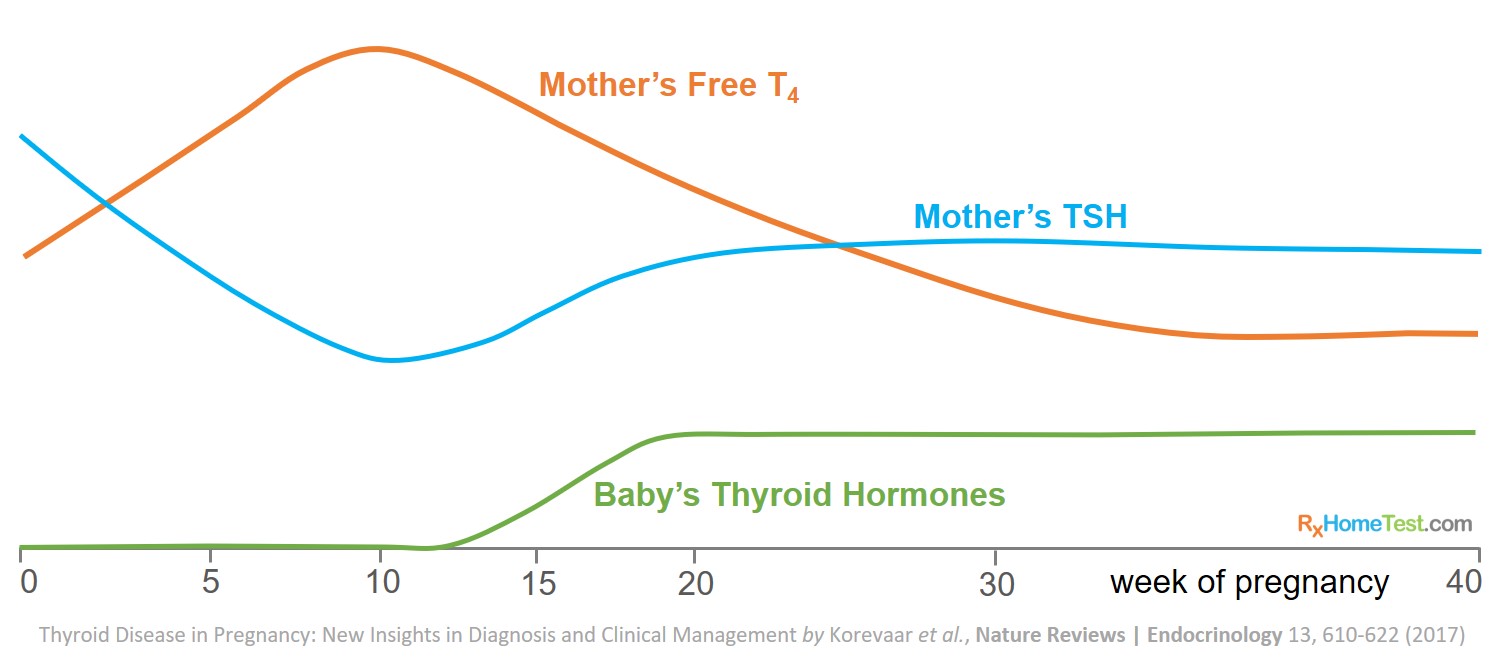
Figure: Thyroid hormone levels in pregnancy. (Reference: Thyroid disease in pregnancy: new insights in diagnosis and clinical management by Korevaar et. al. in Nature Reviews Endocrinology, 2017.)
Q: Can I purchase the test across US?
A: Except New York our tests are available in all 49 states.
State regulations in NY do not allow us to ship the tests to their residents; therefore they should receive, collect and mail it from an address outside their state.
Q: What does the kit contain and how do I use it?
A: The kit for our at-home Women's Hormone Health Test contains a few lancets, a blood collection card, instructions on how to collect the sample, and a form requesting basic information including date and time of collection.
For orders within US, we include a prepaid return envelope.
Orders outside US require you to ship the sample back to the lab in US, but we provide all the necessary paperwork for cross-border shipping.
Q: How long does it take to receive the results?
A: According to USPS, most kits are delivered within 3-5 business days (you can also opt for faster shipping).
After you ship the sample and it is received by our lab, results are normally available within 5-7 business days.
Q: What do I expect from the report?
A: The report with your test results will be easy to understand and will have all the necessary details.
It will mark your hormone levels on a range expected for healthy levels. The report will also specify what are the expected low and high ranges.
It will briefly discuss what your numbers mean and what next steps should be taken to maintain healthy levels.
Q: Can I use my insurance to pay for the test?
A: You can use HSA (or FSA/MSA/HRA) accounts to pay for the tests since these are prescription tests (for further confirmation, please check the IRS publication#969).
However, please ensure you are not going outside your specified max and min deductible limits.
We do not have the capability to process the insurance claim. Since insurance plans vary for individuals we can not guarantee your HSA payment will always be processed by your plan.
We suggest talking to your insurance provider if you have any questions.
Q: How reliable are my results?
A: We have partnered with CLIA-certified labs that are used by physicians across the US.
These labs are regulated by the states, as well as Centers for Medicare and Medicaid Services (CMS).
Majority of the tests from these labs are FDA approved to ensure they meet the proper regulatory requirements.
Additionally, the College of American Pathologists (CAP) requires inter-laboratory tests to ensure the ranges established by each lab do not drift or are not out of acceptable ranges.
This is done by regularly testing reference samples between different labs.
Finally, the labs test thousands of sample for different age groups and health conditions, and have well established reference data to compare your results against this large pool.
Q: Can you recommend what therapy should I take if my levels are low?
A: Unfortunately, no. As a lab test provider we can only test and report out data from your samples.
We are not authorized to provide any medical recommendations.
But we strongly encourage you to discuss the results with your doctor for next steps.