This comprehensive at-home Liver Function Profile includes nine key markers to check liver cell health, organ function, health of bile duct and pancreas.
The test can help check early signs of fatty liver disease and potential impact from liver damaging factors such as alcohol, viral infections and medication.
Our Liver Function Test is simple, reliable and requires just a few steps:
Order Online.
Receive Your At-Home Liver Function Test Kit and Collect Sample at Home.
Ship It Back For FREE* To Our World-Class CLIA Labs.
Receive Secure, Confidential, & Easy-To-Understand Report Within Days** for Your Comprehensive At-Home Liver Function Profile Test.
* Includes free shipping of the kit to Canada & most other countries. Free sample return shipping to the lab is available only within US.
** Please allow sufficient time to receive the kit, return the sample and testing by the lab.
A: The liver function screening test is used to check risk of fatty liver disease and overall liver and pancreatic health.
The test includes nine key markers including enzymes produced by the liver.
Since there are no obvious symptoms of fatty liver disease, the test can help determine if and where the damage to liver might be happening.
Based on specific markers, it may be possible to identify the root cause and help your doctor provide a possible diagnosis path.
For example, higher values of ALT and AST enzymes often indicate damage to liver cells, possibly due to alcohol, hepatitis (A, B, C) or autoimmune diseases (this type is called hepatocellular pattern of damage).
In contrast, damage to bile duct results in higher values of ALP and GGT enzymes, often due to gallstones or drug interactions (often called cholestatic patten).
A: The test report includes nine markers (note: the ranges might vary between different labs, depending on equipment, methodology, and various other factors):
ALT (alanine transaminase) - an enzyme in the liver that leaks into the blood when liver is damaged; optimal values are normally below 45 IU/L.
AST (aspartate transaminase) - another enzyme made by the liver; optimal values are typically below 35 IU/L.
ALP (alkaline phosphatase) - found in liver and bile; high levels indicate liver stress and potential blockage in the bile duct; optimal ranges are normally 30 to 120 IU/L.
GGT (gamma-glutamyl transferase) - another enzyme found in the liver and bile duct; optimal values are generally below 30 IU/L.
Total Bilirubin - bilirubin is a waste product of liver and an indicator of liver health; high levels are flags for jaundice, potential liver and bile problems; optimal ranges are about 2 to 17 micromoles/L.
Albumin - is a protein made by the liver; low values indicate liver stress and dysfunctions; optimal values are normally 40 to 60 g/L.
Lipase - a protein from pancreas; high values indicate inflammation and damage.
Amylase - another protein made by the pancreas, also indicates pancreatic problems when found in excess.
Homocysteine - a building block of proteins; high levels affect cardiovascular health & low folate (B12) levels; high values are shown to cause fatigue & low motivation.
A: These markers are used to assess the risk associated with fatty liver disease, inflammation & infection of hepatitis B or hepatitis C, Cirrhosis, liver cancer, and alcohol use disorder.
Alcohol: AST to ALT ratio over 2 suggests alcohol abuse; GGT is also usually higher in such cases.
Viral infections: Several viruses are known to increase rise in LFT markers & can cause hepatitis (including hepatitis A, B, C, D, E); viruses known to affect the liver include HIV, CMV (Cytomegalovirus) and EBV (Epstein-Barr virus).
Fatty liver disease: both AST and ALT are elevated (and other markers being normal) for those with excess weight, above normal cholesterol and lipids, and predisposition to diabetes.
Autoimmune disease: increase is also seen in people with autoimmune disease giving rise to chronic hepatitis, liver inflammation, and high risk of cirrhosis; women are about four-times at higher risk.
Genetic disorders: certain genetic disorders, e.g., alpha1-antitrypsin deficiency, can cause liver damage; hereditary conditions causing excess iron (hemochromatosis) and excess copper (Wilson disease) can also damage the liver leading to elevation in liver markers.
Others: Both Celiac disease and thyroid disorder may also increase the liver enzymes.
A: As the term says, excess fat in the liver can cause fatty liver disorder.
The fat build up might be simply from excess weight, or due to lifestyle and other reasons (e.g., excess alcohol use).
Excess fat can cause inflammation, and over time damage the liver causing fibrosis (eary, reversible scarring of liver tissue) and cirrhosis (irreversible, permanent scarring and loss of functionality).
The biggest challenge is the silent nature of the condition, as the symptoms are difficult to notice at early stages.
Broadly, the cause may be alcohol (alcoholic fatty liver disease, AFLD) or lifestyle and metabolism (non-alcoholic fatty liver disease, NAFLD).
Without any clear symptoms, a liver function test become an important step in assessing the risk of fatty liver disease.
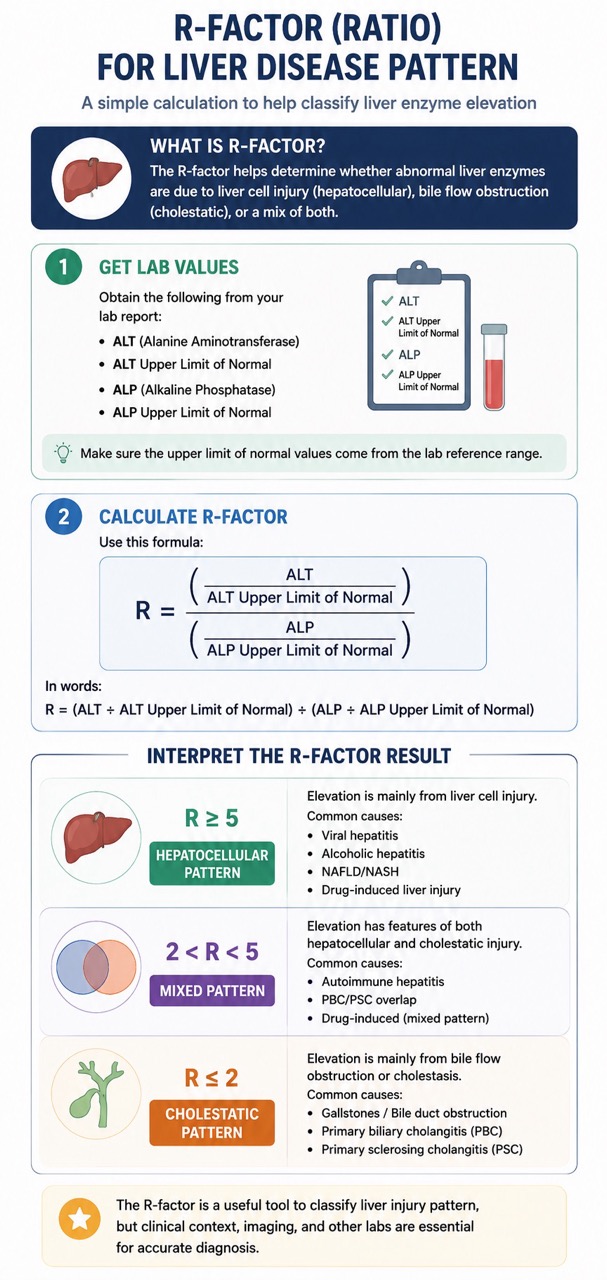
A: R-Factor is a method to calculate and identify the type of injury to the liver, based on the markers from liver function test.
It takes a ratio of two values:
ALT value divided by the upper value displayed in the ranges shown in your report (e.g., if the lab shows values range from 0 to 45 IU/L, use this later value of 45).
ALP value divided by the upper value in the range of ALP values shown in the report.
The ratio of these two decides whether the damage is happening to the liver cells (hepatocellular) or the bile duct (cholestatic):
R = 5 or higher: hepatocellular damage, directly to the liver cells, possibly due to viral infection, alcohol or certain medication.
R = 2 or lower: cholestatic damage, i.e., blockage of the bile duct; e.g., due to actual blockage from gallstones etc. or insufficient production of the bile.
R values between 2 and 5: mixed damage, both to the liver cells and bile duct; often seen in autoimmune diseases or drug interaction.
Once you have the results, try one of the calculators to find the values yourself.
Few factors that can confound your results and should be carefully noticed:
AST values can increase due to certain heart related conditions.
ALT values tend to rise during the day, with highest in the afternoon; they also increase with higher BMI but reduce with exercise. ALT also increases after eating, so samples should be collected in the morning before eating.
ALP values increase during pregnancy, especially in third trimester; unexplained values should be re-tested with a fasting sample.
To understand the role of lipids and cholesterol, you can also order a comprehensive at-home lipids panel.
A: Except New York and New Jersey most of our tests are available in all 48 states. State regulations in NY, NJ do not allow us to ship the tests to their residents.
A: The kit for our at-home liver function test contains a blood card to collect few droplets of blood, a pair of lancets for finger-pricking, instructions on how to collect the sample, and a form requesting basic information including date and time of collection.
The directions are straightforward and easy to follow.
A: You will receive the kit normally within 3-5 business days with a prepaid return envelope (for orders within US).
After you ship the sample back and it is received by our lab, results are normally available within 5-7 business days.
For orders outside US, we provide shipping to your address. However, you will need to find a way to return the sample back to the lab in US.
Your kit will include the necessary paperwork for cross-border shipping.
Note: Once collected, the sample is valid for 12-14 days at room temperature. Therefore, please plan the shipping accordingly to avoid expiration and rejection.
A: The report for your liver function test will be easy to understand and will have all the necessary details.
The report will also specify what are the expected low and high ranges. It might briefly discuss what your numbers mean and what next steps should be taken to maintain healthy levels.
A: You can use HSA (or FSA/MSA/HRA) accounts to pay for the tests since these are prescription tests (for further confirmation, check the IRS publication#969). However, please ensure you are not going outside your specified max and min deductible limits. We do not have the capability to process insurance claims. Insurance plans vary by individuals, therefore we cannot guarantee your HSA payment will always be processed by your plan. Please talk to your insurance provider if you have any further concerns. Reach out to us for an itemized invoice, if you need to submit one.
A: We have partnered with CLIA-certified labs that are used by physicians across the US. These labs are regulated by the states, as well as Centers for Medicare and Medicaid Services (CMS). Majority of the tests from these labs are FDA approved to ensure they meet the proper regulatory requirements. Additionally, the College of American Pathologists (CAP) requires inter-laboratory tests to ensure the ranges established by each lab do not drift or are not out of acceptable ranges. This is done by regularly testing reference samples between different labs. Finally, the labs test thousands of sample for different age groups and health conditions, and have well established reference data to compare your results against this large pool.
A: Unfortunately, no. As a lab test provider we can only test and report out data from your samples. We are not authorized to provide any medical recommendations. But we strongly encourage you to discuss the results with your doctor for next steps.
A lipid function test is one of the most common and convenient tests ordered regularly.
An at-home lipid profile can help check your key markers to confirm early signs of fatty liver disorder and whether you need to make any lifestyle changes to stay healthy.
Abnormal lipid enzymes increase the risk of fibrosis and cirrhosis and are often one of the first tests recommended to monitor liver health.
An at-home lipid test is easy, convenient, and can help check your markers right from the comfort of your home, without the need to visit a lab or doctor's office.
Better health results in better quality of life, and a regular at-home lipid function test from RxHomeTest.com can offer insight not only into your health symptoms, but it can serve as a motivation to treat each of these symptoms and have a better quality of life!
7 reasons to order an at-home lipid function test kit from RxHomeTest.com:
No lab visits or doctor appointment
Dry blood finger prick test (doesn't need a blood draw from a professional)
World class CLIA-certified labs
Physician reviewed results
Fast, secure, and confidential reports
Free First Class shipping (and free return shipping within US)
Qualifies for payment using HSA/FSA
Still wondering where to get a liver and pancreatic health test?
Each at-home health test from RxHomeTest.com includes a physician’s prescription, supplies for self-collection, and free shipping. All orders include a detailed report with your test results explained clearly in a manner that you can understand.
RxHomeTest.com is one of the best places to get tested for diabetes and prediabetes as we process your tests at the same CLIA-Certified labs that other doctors use but no lab or doctor visit is necessary.
RxHomeTest.com offers one of the best tests for liver health with convenient, confidential, and reliable results at some of the lowest prices in the market.
An at-home fasting liver test is quick and easy, can be ordered online, and doesn’t require a doctor’s visit or prescription. This saves time and money on visits to the doctor and the lab.
The at-home liver function profile test ordered at RxHomeTest.com, requires just few drops of blood using a finger-prick (instead of vials of blood taken through venipuncture).