H. Pylori Antigen Test
This FDA-approved test is used to detect H. Pylori antigen in the stool.
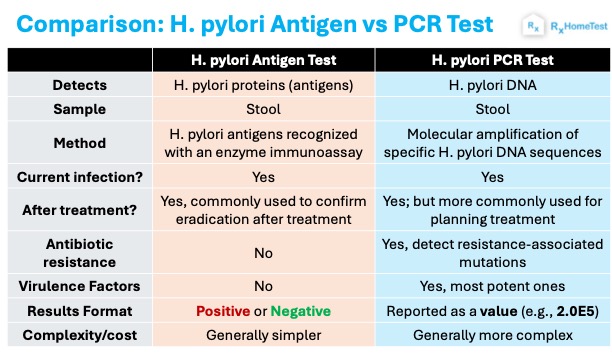
Unlike a PCR test (that checks the DNA of the virus), it directly checks the presence of Helicobacter pylori bacteria through their antigen proteins.
It's an enzyme immunoassay (EIA) that uses an in-vitro qualitative procedure to report the results as 'Positive' or 'Negative'.
Test results can help in diagnosis of H. Pylori infection and monitor current or past treatments.
Another option: a PCR Test that checks DNA of H. pylori bacteria, key Virulence Factors and your Antibiotic Resistance Genes; this extra info can help plan a treatment uniquely around your infection.
Our H. Pylori Stool Antigen Test Kit, collected at home, is easy, reliable, and requires just a few steps:
Order Online.
Receive The H. Pylori Antigen Home Test Kit And Collect A Sample From The Comfort & Privacy Of Your Home.
Ship It Back For FREE* To Our World-Class CLIA Labs.
Receive Secure, Confidential, & Easy-To-Understand Report Within Days** For The H. Pylori Antigen Test At Home.
* Includes free shipping of the kit to Canada & most other countries. Free return shipping of the sample back to the lab is available only within US.
** Please allow sufficient time to receive the kit, return the sample and testing by the lab.
What is H. Pylori Antigen Test?
The H. Pylori Antigen Test is an FDA-approved non-invasive stool test that detects antigens (proteins) from Helicobacter pylori.
H. pylori are bacteria that can infect the stomach lining and may contribute to gastritis and stomach ulcers.
Unlike an antibody test (which checks antibodies produced against the bacteria), it detects the antigens (or proteins) of the bacteria as an evidence of a current infection.
Also, it differs from a PCR test which checks for the DNA of bacteria.
The H. pylori antigen test is often used to help monitor whether treatment has successfully cleared the infection.
What does the test measure and how it compares with a PCR test?
The test only checks the proteins (also called antigens) made by H. pylori bacteria.
Both tests have their unique advantages.
A PCR test can help better plan your treatment (as it can tell the severity and resistance against various antibiotics).
An antigen test checks for actual bacteria and useful in confirming the eradication of the bacteria after a treatment.
This table below compares it with an H. pylori PCR test.
An antibody test is good for checking family members as it can tell who else might be infected.
However, it can't differentiate between current and past infections because once the antibodies are produced, they might continue to show even after treatment.
Who should check for h. pylori?
Although Helicobacter pylori is very common, it may not always require intervention.
But anyone with the following symptoms should get tested:
A slow, dull, constant stomach pain (that's different from a heartburn - which is usually more common in the food pipe, above the stomach)
Pain observed 2-3 hours after eating or during empty stomach
Stomachache that might reduce with antibiotics, probiotics or PPIs but returns
Pain that appears every few days
Nausea
Swelling and bloating
Burping
Vomiting, often with color of coffee (due to bleeding)
Loss of appetite
Weight loss
Blood in stool
How to test for Helicobacter Pylori?
We offer multiple options for testing the presence of H. pylori.
Simply order the h. pylori test kit that you prefer, collect the sample at home, ship to our world class CLIA-certified labs, and find out your results within days.
The kit will provide easy-to-use sample collection supplies and you will receive a physician reviewed report that you can share with your doctor.
Be informed, read more...
Learn more about H. Pylori test at home from Cedars-Sinai here and find out what is the most accurate test for h pylori.
The National Institute of Health suggests regular washing of hands and maintaining hygiene can keep gut health in check.
Q: Can I purchase the test across US?
A: Except New York our tests are available in all 49 states and DC.
State regulations in NY do not allow us to ship the test kits to their residents and the lab might not be able to test.
See the note above for NY.
We also ship to Canada and rest of the world.
Q: What does the kit contain and how do I use it?
A: The H. pylori at-home antigen test kit contains stool collection supplies, instructions on how to collect the samples, and a form requesting basic information including date and time of collection. The directions are straight forward and easy to follow.
Q: How long does it take to receive the results?
A: In most cases, the USPS delivers the kit within 3-5 business days. For orders within US, we include a prepaid return envelope (for orders outside US, shipping to your address is included but you will need to mail the sample back to the US lab; we will include the necessary paperwork for cross-border shipping).
After you ship the sample for your H. pylori antigen test and it is received by our lab, you get the results in most cases within 5-7 business days.
Q: What do I expect from the report?
A: The results for your H. pylori home test kit will be easy to understand and will have all the necessary details.
It will mark whether you are negative or positive for the bacteria.
A short explanation of your results will also be included.
Q: Can I use my insurance to pay for the test?
A: You can use HSA (or FSA/MSA/HRA) accounts to pay for the tests since these are prescription tests (for further confirmation, please check the IRS publication#969). However, please ensure you are not going outside your specified max and min deductible limits. We do not have the capability to process the insurance claim. Since insurance plans vary for individuals we can not guarantee your HSA payment will always be processed by your plan. We suggest talking to your insurance provider if you have any questions.
Q: How reliable are my tests and how do I ensure my results are accurate?
A: This is an FDA-approved test.
First, this test is similar to many other antigen tests. It checks the presence of H. pylori bacteria with looking at the proteins made by the bacteria.
Second, to minimize the possible variations from sample collection, we provide detailed h pylori stool test instructions and videos to collect the sample.
Finally, to minimize the variation from labs, we have partnered with CLIA-certified labs that are regulated by the states, as well as Centers for Medicare and Medicaid Services (CMS). Many tests from these labs are FDA approved to ensure they meet the proper regulatory requirements. Additionally, the College of American Pathologists (CAP) requires inter-laboratory tests to ensure the ranges established by each lab do not drift or are not out of acceptable ranges. This is done by regularly testing reference samples between different labs. Finally, the labs test thousands of samples for different age groups and health conditions, and have well established reference data to compare your results against this large pool.
Q: Can you recommend a therapy if my numbers are high or low?
A: Unfortunately, no. As a lab test provider we can only test and report out data from your sample. We are not authorized to provide any medical recommendations. But we strongly encourage you to discuss the results with your doctor for next steps.