Article

As a potential anti-aging and longevity marker, the gene VS-KLOTHO has very promising future, especially for APOE4 carriers.
The KLOTHO (KL) gene is responsible for making a protein with the same name.
Studies on mice show that higher levels of this protein can increase life span. Therefore, KLOTHO is considered an 'anti-aging' marker that may offer protection against dementia and Alzheimer's, especially among those carrying the APOE4 genes.
Overall, KLOTHO has many benefits as anti-inflammatory, anti-oxidative, anti-fibrotic, tumour-suppressive and anti-hypertensive marker with potential role in human longevity.
VS-KLOTHO: There are three mutating regions for KLOTHO, the two of interest occur at F352V and C370S on chromosome 13; that's why you might often hear the term VS-Klotho.
Not everyone has the variant, only about 20% of the people have a mutation at this location.
The KLOTHO gene was discovered in 1997 by chance, when it was noticed that mice with certain gene variety showed very short life span and had all the signs of premature aging. They had several health issues related to heart, bones, infertility, skin, lungs and other organs.
Table of risk levels based on genetic mutations:
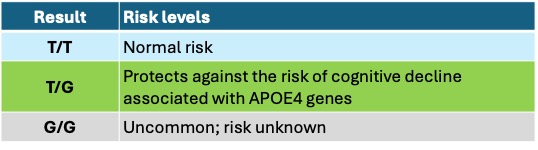
While T/T genotype variant has normal risk, the T/G variant protects against the risk of cognitive decline associated with APOE4 genes and other aging processes.
The G/G variant is not very common and risk is unknown.
KLOTHO is one of the rare cases where the (heterozygous) mutation is actually beneficial (i.e., having a different 'option' from each parent helps).
Most discussion around anti-aging effect of KLOTHO is about VS-KLOTHO (VS-KL), which is found in about 20% of the population, and mutations at this region might protect against APOE4 genetic risk.
In humans, KL protein is mainly produced in the kidneys and brain or in smaller amounts across the body, e.g., in the parathyroid gland (a tiny gland behind the thyroid). It's main roles involve calcium, phosphorus and vitamin D absorption in the body.
Certain mutations of KL proteins increase the risk of hypertension and kidney disease.
The circulating KL protein has three forms:
α-KL (alpha-Klotho) - occurs as a soluble hormone form that circulates throughout the body and one that binds to the cells (made by a gene on chromosome 13). The three gene varieties discussed are relevant to this form.
β-KL (beta-Klotho) - not fully investigate yet (from a gene on chromosome 4); mainly produced by fat cells, skeleton muscles and heart.
γ-KL (gama-Klotho) or KLrp (Klotho-related protein) - whose function is unclear (from a gene on chromosome 15); found throughout the body but has the least activity among the three forms.
Most of discussion about Klotho proteins is related to alpha-Klotho (α-KL), especially for those interested in VS-KLOTHO.
The α-KL protein has two different forms.
One form circulates throughout the body to give all the known benefits of this protein. It acts as a hormone with anti-inlammatory, anti-oxidative stress and tumor-suppressive properties.
The second form binds to the cell and it's most important role in kidney health.
Both these forms of α-KL protein are mostly found in kidneys & brain.
It regulates calcium, phosphorus and Vitamin D absorption. It also helps in anti-aging, improves kidney health, and reduces hypertension. Other benefits include improvement in insulin sensitivity, lowering blood sugar and thus reducing the risk of diabetes.
Stress, inflammation, hypertension, diabetes, and kidney failure seem to lower α-KL levels. Also, things that reduce expression of α-KL include hydration, diabetic nephropathy and oxidative stress (e.g., alcohol);
The beta-KL (β-KL) is a distinct protein, but has been difficult to isolated for studying so far. But it mainly seems to work in the liver and fat cells where it helps convert glucose into energy, supports metabolism, and gut (bile) acid release.
Multiple studies show the important role in aging:
It has been observed that levels of Klotho protein drop with age and but doesn't seem to depend on gender or sex. See the figure below.
The VS-Klotho heterozygous variant offers clear advantages over homozygous variant for stroke, cardiovascular diseases (CVD), and markers of heart health such as cholesterol and blood pressure pressure.
α-KL protein levels are also predictors of mortality in group studies and lower levels increase the risk two-fold.
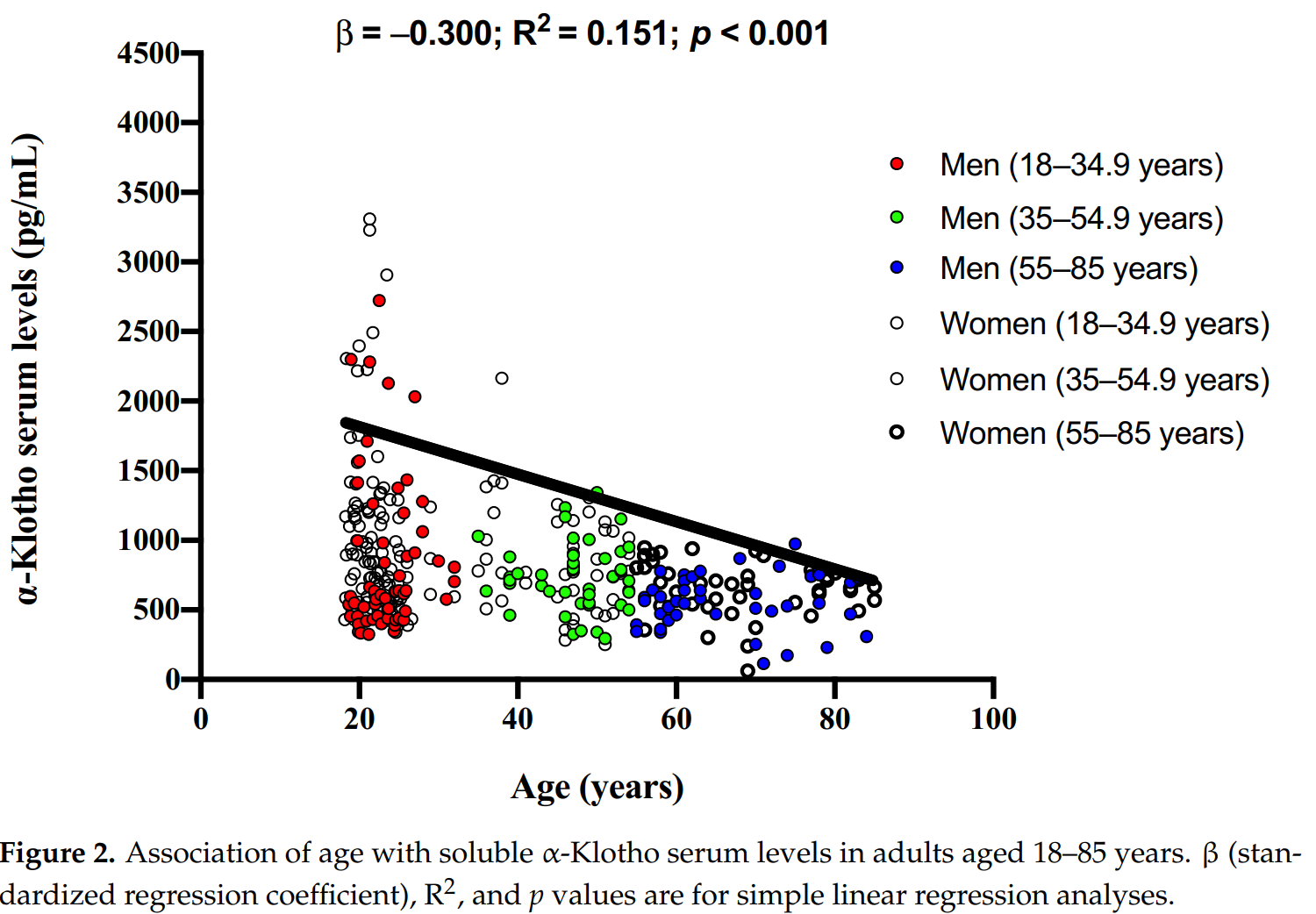
Source: "References Values of Soluble α-Klotho Serum Levels Using an Enzyme-Linked Immunosorbent Assay in Healthy Adults Aged 18–85 Years", by A. Espuch-Oliver et. al., J. Clin. Med. 2022.
The word Klotho (or Clotho) comes from Greek mythology in which the three Moirai ('destinies') decide fates of humans at birth by spinning the thread of life: Klotho (spins the thread), Lakhesis (measures the length), Atropos (cuts it) to control the ultimate fate of human life.
Klotho was first discovered in 1997 by a Japanese group that observed genetic defects in mice caused 'short lifespan, infertility, arteriosclerosis, skin atrophy, osteoporosis and emphysema'.
Levels of Klotho protein drop with age independent of gender or sex.
Klotho helps in hypertension and renal disease through lowering oxidants, reducing NO (nitrous oxide), raising IL-10 (anti-inflammatory marker).
The heterozygous (T/G) VS-Klotho shows clear advantages over homozygous variants (T/T, G/G) for American Heart Association's markers of Life's Essential 8™ markers of heart health such as cholesterol and blood pressure pressure. Therefore, benefits include those related to stroke, cardiovascular diseases (CVD), diabetes and kidney diseases.
In two different studies the heterozygous VS-KL variety offers clear benefits in longevity: better blood pressure, fewer strokes, and higher chances of living longer at later stage of life (compared to those with homozygous alleles).
α-KL protein levels are also predictors of mortality in population studies and suggest that lower levels increase the risk two-fold and correlation to short-term survival at advanced ages (e.g., 5-year prediction).
The protein KLOTHO is found in blood, urine and cerebrospinal fluid. Therefore, a blood test to check aging might be possible some day.

Order an at-home APOE genetic test kit.
APOE and Correlation to Alzheimer's, CVD, and Dementia - Learn more about the risks from APOE genes in detail.
Role of APOE in Alzheimer’s and Longevity - Learn how APOE4 genes affect longevity and risk of dementia and Alzheimer's.
APOE4 and Alzheimer’s - FAQs - ApoE4 is the biggest predictor of Alzheimer's disease.
Genetic Testing and Disease Inheritability - How to know genes affect the diseases we inherit.
Genetic Variants of Heart Disease - Look at all the markers responsible for affecting heart health.
Celiac Disease and Genetic Risk - Celiac is one of the diseases with very clear genetic causes.
How to Read a Celiac Genetic Test Report - Learn which genes you have that can cause gluten allergy.
MTHFR gene and Heart Health - Learn more about risks due to certain MTHFR genes to your heart.
